Showing posts with label instruments. Show all posts

Saturday, November 25, 2023

TE probes benchmark from in-flight measurement

Following to 2022 first measurements & findings using XC vario, I have bought two TE probes from ESA systems last winter, to be flown & recorded over 2023 season.


  • Venturi is the TE probes I have flown over years, it was my reference
  • TE-RU is the "standart" bent TE antenna. It can be installed on tail either pointing up or down
  • TE-DN is the double-head type of TE antenna. It can be installed either vertically either horizontally

It means the same glider can be flown in 5 differents TE Antenna configurations, for comparison purpose.

It is a bit difficult to judge from reading the instrument in flight what are the specificities for each arrangement. Still what could be nevertheless be seen is that pneumatic vario reading looked less jumpy in maneuver with either TE-RU or TE-DN in comparison to the reference TE-Venturi.

Let's see what we can learn from XC-vario recording.

As a standart maneuver, for each of the flights with a new antenna configuration I did perform a phugoid, which allows to cover a large range of airspeed in straight flight with minimum piloting input & with acceleration & deceleration.

Measured pressures during phugoid

From those pressure recordings it is possible to evaluate "Antenna pressure coefficient", by combining Static pressure PS & total pressure Q along with TE pressure through :
CP_TE=(PTE-PS)/Q.
  • To perfectly compensate speed variations in vario reading, from a theoretical point of view antenna pressure coefficient value should be equal to -1 .
  • If pressure coefficient is above -1, antenna is undercompensating
  • If pressure coefficient is below -1, antenna is overcompensating

(NB : the value of -0.95 is sometime stated as desired pressure coefficient value, based on pilot feedback from experiment)

Here are the results from measurements :

Antenna coefficient for the 5 configurations, in phugoid

Since anemometric system for LS6 glider is carying only small speed errors (see link) - at least for symetric flight - PS & Q can be trusted & antenna coefficient can be considered in absolute.

The following trends can be observed:

  • TE-Venturi is overcompensating, by about ~7% whatever speed (as from last year analysis)
  • TE-RU gives a more exact compensation when pointing down, particularly for cruise flight speeds
  • TE-RU tends to overcompensate at lower speeds when pointing up, and undercompensate when pointing down
  • TE-DN gives a more exact compensation in cruise when set horizontally, while giving a more exact compensation in low speed range when set vertically.
  • TE-DN tend to undercompensate at low speed when set horizontally, and over compensate in cruise speed when set vertically
Based on straight flight analysis, both TE-RU pointing down & TE-DN set horizontally seems to be two equivalent best choices for good compensation in cruise flight.


Recording pressure signals over the full flights overs the opportunity for wider analysis. I have for example extracted the time history for the first thermal for flights with each configuration.

Here is the result from measurements :

Antenna coefficient for the 5 configurations, in circling

The following trends can be observed:

  • The whole range of pressure coefficients seems shifted in circling compared to straight flight : it could be caused either by antenna behavior, either by error in anemometric circuit for circling conditions - since PS is used as reference for evaluating pressure coefficient.
    Second cause is likely the main driver, so it makes sense to only consider circling measurement for comparing antennas & not in absolute.
  • For both TE-RU & TE-DN, there is less compensation difference between antenna orientations in circling phases compared to straight flight.
  • TE-DN is compensating less than TE-RU in circling flight

Based on circling analysis, antenna orientation seems less critical in circling than in straight flight, but it is difficult to state for sure which antenna configuration is better compensating, due to likely static circuit errors.

All in all, I think it is clear I will not fly anymore my TE-Venturi antenna : general feeling in flight & recordings analysis goes in same direction.
Further study on the noise over pressure measurement could help choosing between TE-RU & TE-DN antennas, but will require first to sort what comes from air bumpiness from the day versus antenna behavior in the observed signal. To be continued !



Tuesday, October 25, 2022

TE probe characteristics

As XC Vario is recording the different pressures available on my glider, namely static PS, dynamic pressure Q & TE probe PTE, it is possible to study them.
Anemometric calibration curve of LS6 being quite good, as showing low error of IAS vs CAS, it means in particular than static measuremnt is of good quality.

DLR-measured anemo calibration curves for LS6 (1986)

As a result, it is possible to build TE pressure coefficient with a reasonable confidence in the absolute level. TE pressure coefficient is defined as follows :

CP_TE=(PTE-PS)/Q

To have a good compensation antenna, value for this pressure coefficient should be CP_TE=-1.
Now, let's see what we measure in flight on the LS6, which is fitted with a venturi-type compensation antenna. 

First, a phugoid manoeuver is showing a good range of speed with minimum stick input. Below is plotted the antenna pressure coefficient as function of indicated airspeed.

TE pressure coefficient in phugoid

It can be observed that my antenna is not a perfect, as being 5 to 10% off vs desired value for typical cruise speeds.
As pressure coefficient is more negative than desired, it means this antenna has a trend to over-compensate altitude variation for speed variations. In a typical pull up on a modern glider, speed variation  vs geometric altitude variation corresponds to a ~10m/s correction term, meaning a 5% error on the coefficient makes ~0.5m/s error on variometer reading.
As well to ne noted : when reaching low speed range, the antenna over-compensation behavior is increasing.

In real life, TE pressure is exposed to many perturbations : turbulence, sideslip, angle of attack, pilot input, etc... Ideally the local pressure coefficient would stay imune to those parameter, but this is actually  not the case. As a result, TE pressure is affected by some measurement noise, that is at the end polluting variometer readings.
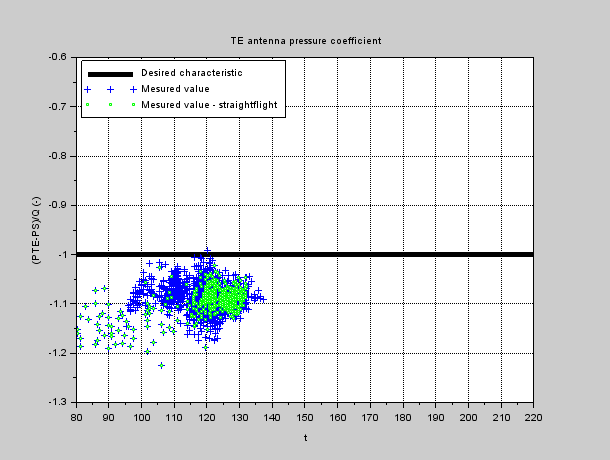
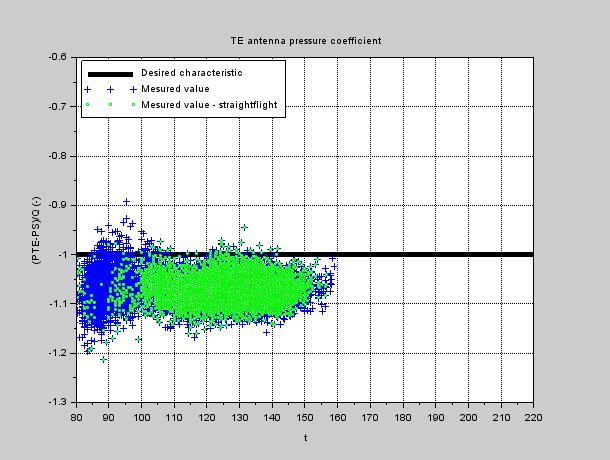
Below is the TE pressure coefficient recorded over 30min during one of my XC-country flight, showing an example of "real life" situation.

TE pressure coefficient while flying in southern alps, from Col de Vars to Crete de Peyrolle

In contrast to the relatively ideal phugoid manoeuver, it can be observed that pressure coefficient versus speed is quite noisy, especially for low speed, with either over- or under-compensation behavior.
When on top we isolate points corresponding to wings levels (in green), it appears that the low speed noise is very much related to circling phase. In thermals, probability for turbulence or for non symetric flight is higher, both likely to expose TE probe to undue perturbations. Noise is less in straight flight, but does exist as well.

Below is a collection of time slices analysed from a TE antenna characteristic, to start getting a sense of statistics & patterns. From left to right & top to bottom : clound street flying, low altitude hang flying, High mountaign area flying, low start over hill in weak lift, small wave flying, landing


 Performing similar measurement for different antenna would be interesting, but was not done so far.

As a final note, it can be either concluded I have a bad TE antenna, or that reliable variometer without an antenna would be a benefit...


Friday, December 24, 2021

Installing XC Vario

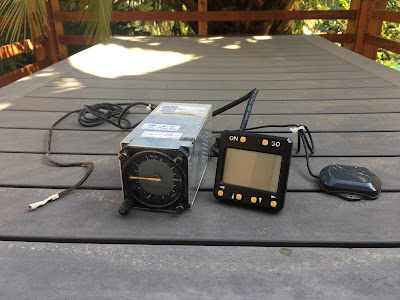
 At the begining of the season, I had dismantled the old C302 vario & have replaced it with a modern instrument : A XC Vario.

The old generation out...

... replaced by a modern tool !

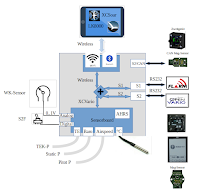
XCVario is in the family of open source varios, with the interest that a very neat hardware can be purchased, while software is opened.


In the main features :

  • Basic sensors covers pressures (static, total & antenna) & temperatures informations for standart altitude & speeds parameter construction
  • Advanced sensors as options providing as well as 3axis acceleros & gyros (AHRS)
  • Full Wifi & Bluetooth connectivity is offered
  • It is compatible with XCsoar 
  • It is ready to receive FLARM information, with a contact display 
More info at :

https://xcvario.com/

https://github.com/iltis42/XCVario


This instrument has been used over 2021 flying season as a starting point for scientific investigations... 


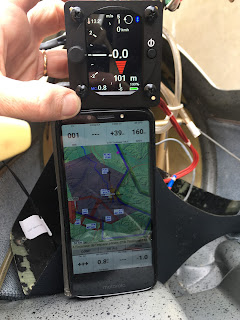
The updated instrument panel


Sunday, March 6, 2016

Troubleshooting of Sage variometer

I have been replacing my pneumatic Winter vario with a Sage (56mm). Its needle agility is good to find small thermal, but he thing is it's behavior is in no way quantative, and it is almost unsensitive to sink so that not really usable for speed to fly (in case on flat battery).

So, with the use of a large syringe, I did some comparative studies of Sage vario & winter, with various configuration of restrictions installed on tubes. Here is the result.